Escapesim for Short Vs. Long Trips: Which Plan Wins?
11/12/2026
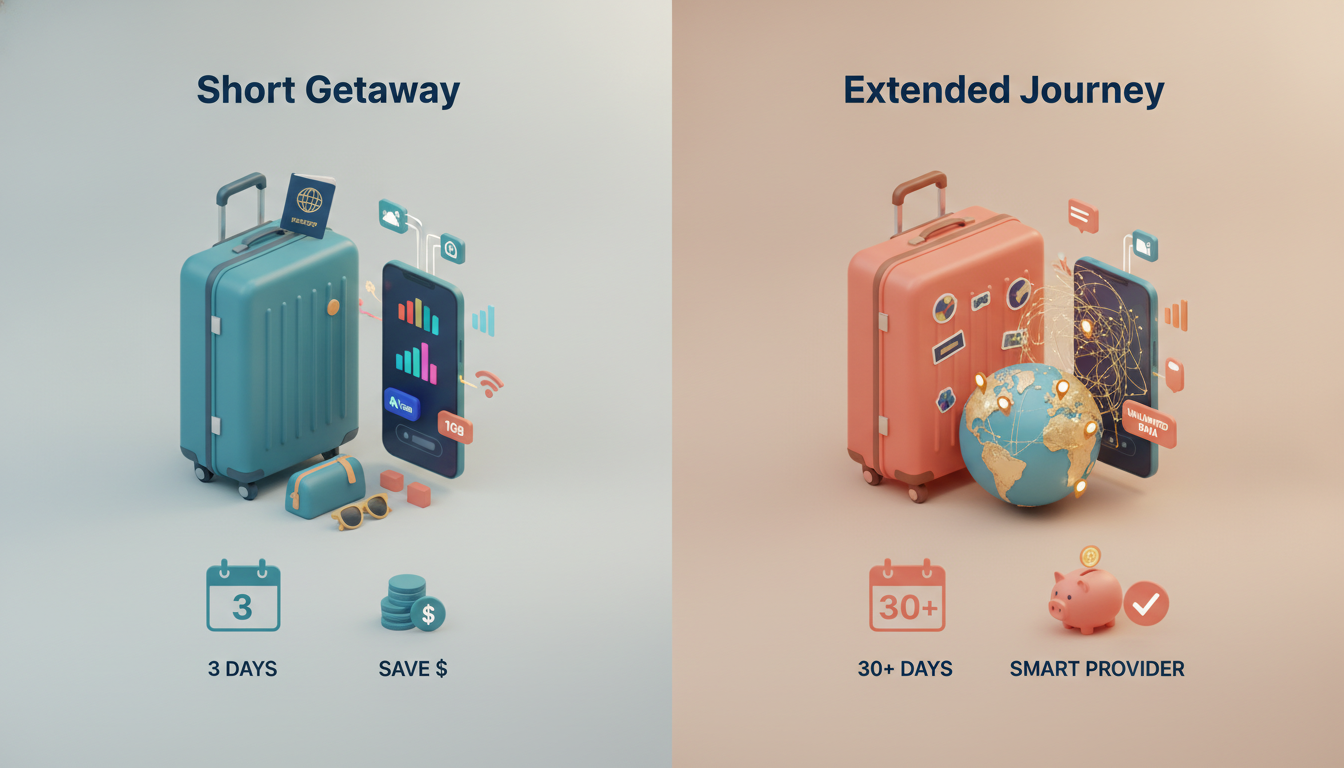
EscapeSIM is a travel eSIM, not an EscapeSim game, virtual escape room, or escape room simulator. It provides prepaid mobile data for international travel, with plans reported for more than 170 countries and regional coverage such as Asia across 28 countries.
The important choice is trip length: short trips need a plan whose validity matches your arrival and departure dates, while longer trips make data allowance, renewal rules, and total cost more important than the headline price.
EscapeSIM Means Mobile Data, Not an Escape Room
The name can easily send you toward searches for an online escape room game, multiplayer escape rooms, or a puzzle-solving game. EscapeSIM belongs to a different category entirely.
Its service is a data-only eSIM for phones and other compatible devices.
EscapeSIM describes itself as 100% Australian-owned, with Australian support and prepaid plans. The App Store listing says its service works in over 180 countries, while the company’s customer-service description refers to coverage in 170+ countries.
That difference matters: coverage claims can vary by page, product, or update, so I would check the destination-specific plan before paying.
An eSIM is a digital SIM profile installed on a compatible device. It does not normally give you a new physical SIM card, and a data-only plan does not automatically provide a local phone number for ordinary calls or SMS.
Your existing SIM can often remain active for calls and texts, but roaming settings must be controlled carefully.
What EscapeSIM Includes
The published EscapeSIM information points to:
- Prepaid mobile data plans
- QR-code installation
- Support for setup, activation, data use, and billing
- Human support advertised as available 24/7
- Regional and country-specific coverage
- Plans ranging from 1 GB to unlimited data
- Validity periods from 1 to 60 days on the listed Asia product
That makes EscapeSIM relevant for both a weekend break and a multi-week trip, but not necessarily for the same reason. A short stay rewards simplicity and a precise validity window.
A long stay rewards a plan that does not force you to buy several small packages at a higher combined cost.
Short Trips Versus Long Trips
A one- to seven-day stay
For a short trip, start with the number of calendar days between landing and departure, then add the time needed for airport transfers and the final journey home. A plan that expires at midnight on its final validity day can leave you without maps or messaging during a late departure.
If you need navigation, messaging, ride-hailing, and occasional browsing, a smaller allowance may be enough. Video uploads, hotspot use, cloud backups, and automatic app updates change the calculation quickly.
I always start by disabling background data for large apps before estimating the package: otherwise the phone can consume data while sitting in a hotel room.
The practical sequence is:
- Confirm that the phone is carrier-unlocked and eSIM-compatible.
- Install the EscapeSIM profile while connected to Wi-Fi.
- Keep the eSIM switched off until the intended travel day if the activation policy allows it.
- Select the eSIM for mobile data after landing.
- Enable data roaming on the travel line, not blindly on every line.
- Check that the network name and data connection appear before leaving the airport.
The trap is installing too early without checking when validity begins. If activation starts at installation rather than first network connection, a seven-day package can lose usable days before the trip has started.
The sign that setup worked is not merely seeing the eSIM listed in settings; it is a successful data connection with the travel line selected.
For a short trip, I’d advise against buying unlimited data automatically. Unlimited plans can be convenient, but if the device will mainly use maps and messaging, the extra cost may buy capacity you never consume.
A two- to eight-week stay
Longer travel changes the decision. EscapeSIM’s listed Asia plans cover 1 to 60 days, and the same product range goes from 1 GB to unlimited data.
That range is useful because a 30-day trip does not necessarily require four separate weekly packages.
A long-stay traveler should check:
- Whether validity is continuous or divided into reusable days
- Whether the allowance resets or ends permanently
- Whether hotspot or tethering is permitted
- Which local networks carry the service
- Whether the plan covers every border crossing
- Whether unused data expires
- Whether a top-up is available after the initial allowance ends
Cross-border travel is where regional plans can justify themselves. The Asia product is described as covering 28 countries on one plan, so you may avoid swapping profiles as you move between destinations.
The trade-off is that a regional plan may cost more than a single-country plan if most of the trip takes place in one country.
A common mistake is comparing the purchase price without dividing it by usable days or included data. A cheaper plan that expires after seven days may become expensive when renewed four times.
Conversely, a large unlimited plan can be poor value when Wi-Fi handles most heavy usage.
Choosing the Allowance Without Wasting Data
The mechanism is straightforward: every connection uses the mobile data allowance unless the phone is on Wi-Fi. Streaming, video calls, photo synchronization, and hotspot traffic consume data much faster than text messaging or map searches.
On a short trip, watch for these settings:
- Automatic photo and video backup
- App-store updates over cellular data
- Social-media autoplay
- High-resolution map downloads
- Personal hotspot connections
- Video streaming while commuting
When background synchronization remains enabled, the phone can spend data on queued photos before you use navigation. The consequence is concrete: the allowance falls while the traveler believes the eSIM is being used only for essential services.
For a long trip, usage monitoring is more valuable than guessing. Set a warning below the plan’s full allowance, then inspect the phone’s per-app data screen after the first travel day.
If one application dominates consumption, restrict it rather than immediately upgrading.
I would also keep the primary SIM available for receiving important SMS only if the home operator’s roaming charges are understood. Leaving both lines active for data can cause the phone to select the wrong connection.
A visible signal bar does not prove that the intended eSIM is carrying traffic.
EscapeSIM Offers and How to Compare the Total Cost
EscapeSIM’s Asia listing starts at $1.59 and advertises validity from 1 to 60 days, but the exact amount depends on destination, allowance, and duration. I would verify the selected country and expiry condition on EscapeSIM before checkout rather than treating the starting price as the cost of a longer stay.
For discount hunting, MyBestSim currently lists these relevant unlimited-data codes. They are not EscapeSIM codes, so they should not be applied to an EscapeSIM checkout:
| Provider | MyBestSim Rank | Rating | Promo Code | Discount |
|---|---|---|---|---|
| Yesim | 2 | 4.8/5 | MYBESTSIM20 | 20% off unlimited |
| Simbye | 5 | 4.3/5 | MYBESTSIM | 20% off unlimited |
| BNESIM | 8 | Not listed | MYBESTSIM | 30% off unlimited |
A discount only helps if the underlying validity matches the trip. Before choosing an alternative provider, compare the final cost for the whole journey, not the percentage alone.
A 20% reduction on an unsuitable seven-day package does not beat a correctly sized 30-day plan.
The verified eSIM promo codes for international travel are useful at the point where you already know the required duration and allowance. For a first-time eSIM user, a free data trial eSIM can also help confirm device compatibility before committing to a longer package, but trial conditions and destinations must be checked individually.
Installation Details That Matter on the Road
Install the QR profile over reliable Wi-Fi before departure, but do not assume installation equals activation. Some plans begin validity when the eSIM first connects to a supported network; others may use installation or another activation event.
The product terms decide which rule applies.
If the connection fails after landing, check these settings in order:
- The EscapeSIM line is enabled.
- Mobile data is assigned to that line.
- Data roaming is enabled for the travel eSIM.
- The home SIM is not selected for mobile data.
- Airplane mode has been toggled once to refresh registration.
- The device has selected a supported local network.
When the eSIM shows signal but applications cannot connect, the usual issue is incorrect data-line selection or roaming permission, not the QR code itself. If the phone connects but speeds drop after heavy use, check whether the plan applies a fair-use or speed-management condition before assuming the installation failed.
FAQ
What exactly is EscapeSIM, and is it an escape room?
EscapeSIM is a prepaid mobile data eSIM for international travel, not an online escape room, simulator, or puzzle game. It installs digitally on compatible, unlocked devices and can provide connectivity across supported destinations. Because it is data-only, it usually does not include a local phone number for ordinary calls or SMS.
How does trip length affect an EscapeSIM plan?
Short trips require a validity period covering arrival, daily travel, and departure, including late airport transfers. Longer trips require closer comparison of total cost, data allowance, renewal rules, and expiry conditions. A low upfront price can become expensive when repeated weekly purchases are needed throughout a multi-week journey.
How much EscapeSIM data does a short trip need?
Maps, messaging, ride-hailing, and occasional browsing generally require less data than streaming, video calls, hotspot use, or photo backups. Disable automatic updates and background synchronization before estimating your needs. For a brief trip, a smaller allowance may offer better value than an unlimited package that provides unused capacity.
Can EscapeSIM support longer trips across multiple countries?
EscapeSIM lists plans with validity periods reaching 60 days and regional options such as Asia across 28 countries. A regional plan can simplify border crossings by avoiding repeated eSIM changes. Before purchasing, confirm every destination, supported networks, hotspot rules, unused-data treatment, and whether the allowance remains active continuously.
How can travelers avoid EscapeSIM activation and roaming problems?
Install the eSIM over dependable Wi-Fi, then verify when its validity begins because installation may not equal activation. After landing, select EscapeSIM for mobile data, enable roaming on that line, and prevent the home SIM from carrying data. Test the connection before leaving the airport and check network registration if service fails.

Marcus Bennett
Marcus is a travel and tech writer who has tested eSIMs and data plans across dozens of countries. At eSIM Promo Codes he tracks down the best working coupons and explains how to stay online abroad without falling into the roaming trap.